|
|
||
|
Click on the images below for more details |
A
C O N S U L
T A T I O N |
|
|
Click on the images above for more details. |
This extremely fine instrument was sold to a private client on 29 October, 2006 and is therefore no longer for sale.`
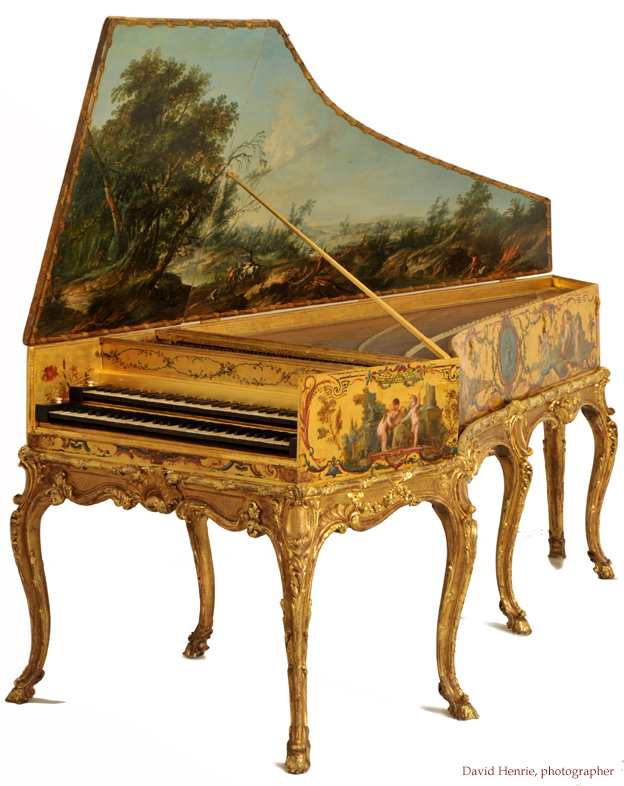
A Franco-Flemish double-manual harpsichord,
originally a transposing harpsichord made in Antwerp,
c.1620 and
ravalé in Paris in 1750 and then refait by Jacques Barberini, Paris, c.1775
Further information along with a detailed analysis of this instrument was published by me as the article 'An Analysis of the Origins of a Large Franco-Flemish Double-Manual Harpsichord - Would a Ruckers by Any Other Name Sound as Sweet?', The Early Keyboard Journal, XX (2005) 49-80.
Details of the original state of the instrument
This
harpsichord was sent from Brazil for examination and study by me, and for the
preparation of a series of reports on its authenticity, condition and suitability
for restoration.
A careful examination of the instrument has revealed
that it was originally a Flemish 'transposing' double-manual harpsichord but, despite the
‘HR’ rose in the soundboard, there is a great deal of evidence which shows
that it was not by any of the members of the Ruckers/Couchet family. The rose appears to be from a genuine
Ioannes Ruckers instrument from his early period before 1614, but it does not
fit into the hole in the soundboard into which it has been placed. On the other hand analysis of the
placement of the original bridge pins for the strings shows that these were
spaced relative to one another using the Antwerp duim (inch) and voet
(foot). In addition markings on the soundboard
indicate that there were the usual doubled pairs of strings for the e
The instrument
is therefore an extremely rare and unusual example of a Flemish non-Ruckers
double-manual transposing harpsichord. Details of the eighteenth-century
state of this harpsichord.
There are clear indications that the original
seventeenth-century Flemish instrument was enlarged in the eighteenth century
to convert it into the standard model 'grand ravalement' 5-octave instrument.
The bottom jacks in each register are dated 1750 and
indicate that this was the date of the conversion of the small Flemish
harpsichord into a grand French double-manual harpsichord. When the instrument was restored in Rio de
Janeiro in 1971 the restorer Roberto de Regina found the signature or calling
card of Jacques Barberini inside the instrument. Jacques Barberini is known from numerous archival
references to have been a harpsichord builder who worked in Paris during the
latter part of the eighteenth century. He is almost certainly the Jacques
(Giuseppe?) Barberini who worked in the Rue de la Verrerie, the same street
in which both Pascal Taskin and Jean Goermans had their workshops[1]. Barberini entered the Guild of the
joiner/instrument builders in 1783, and was responsible for the selling of
English pianos. He is referred to by
Constant Pierre[2] when
mentioning makers who joined the Paris harpsichord makers’ guild after 1775: "De 1783 a 1788: Jacques Barberini, rue de la Verrerie (1783-91), ou il tenait des forte-piano anglais des meilleurs auteurs." Because Barberini did not enter the guild until 1783 it is unlikely that he is the one who carried out the original ravalement in 1750.
The instrument now has an extremely fine decoration and
a stunningly beautiful stand. In the
eighteenth century the instrument would have had four registers with an extra ‘peau de buffle’
register at the rear of the gap. This register was fitted with soft
leather plectra instead of bird quill.
It would have had either a ‘genouillère’ (knee-lever) or perhaps a
pedal system for changing the registration.
Unfortunately the system of pedals was removed from the instrument
in the 1950’s when it was in the hands of a French antique dealer in
Argentina. Equally disastrously both
the ‘peau de buffle’ row of jacks, the baseboard, and possibly the machine
mechanism associated with the genouillère or pedal were removed in the 1971
restoration. There is now virtually
no evidence remaining of the former existence of the ‘genouillère’ or pedal mechanism.
The ravalement framing is very
well designed and carried out, and from a statics point of view provides an
extremely rigid and stable structure to the case. Indeed there is absolutely no sign of any distortion nor
twisting of the case and no evidence that the case could not withstand string
tension if the instrument were restored to playing condition again. Musically it should make an extremely fine instrument and a stunningly beautiful object after restoration. |
|
![]()