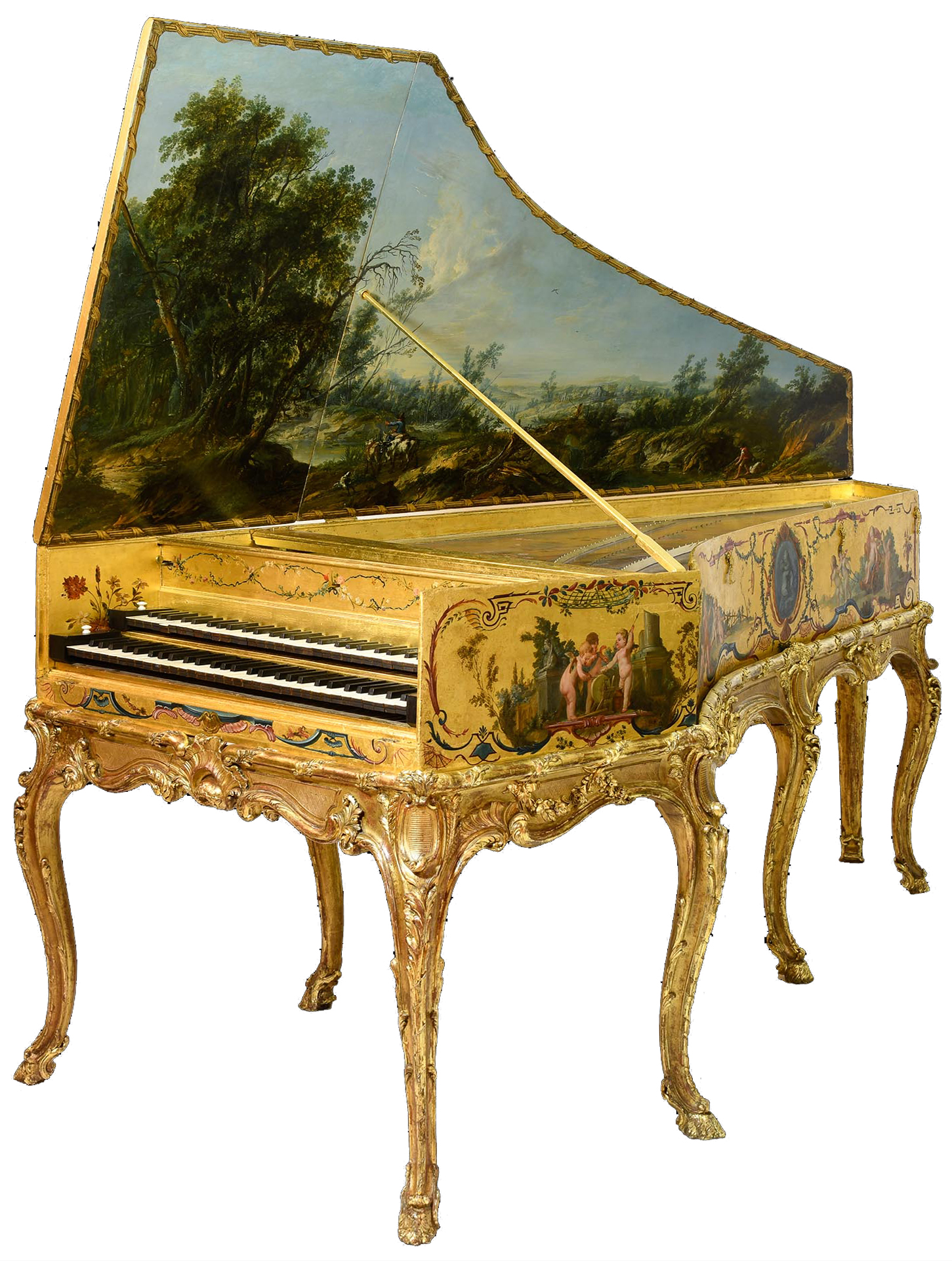
Franco-Flemish double-manual harpsichord,
|
|
This stunning double-manual harpsichord made in Antwerp by Frans van Huffel in 1617, decorated by Francois Boucher and ravalé byFrancois Blanchet in Paris in 1750 IS NOW FOR SALE.
For further details please contact:
[The latter is NOT the owner.] |
This harpsichord was originally built in Antwerp in 1617 by Frans van Huffel, an almost exact contemporary of Andreas and Ioannes Ruckers. Originally it was a typical double-manual Flemish harpsichord with two keyboards at pitches a fourth apart, and with the usual disposition of 1x8', 1x4' and 4 registers - two independent registers for each keyboard. Although it now has a genuine early Ioannes Ruckers soundboard rosette, this rosette is too small for the original size of the hole in the soundboard, and is clearly not the original. But a careful analysis of the structure and design of the instrument shows further that it was not made by any of the members of the Ruckers/Couchet family.
The instrument was mis a ravalement in Paris at some time between 1742/43 and 1750. The exact details of its state during this period is unknown, but it may then have had a compass of F1 to d3, without widening the case on the treble side. With a compass going up to d3, this would have meant lowering the pitch, perhaps by even as much as 2 semitones. In 1750 new keyboards, jacks and registers were made with the bass compass still going down to F1, but with the nuts moved to 'correct' the pitch, and return it to its original level. The instrument then had the unchanged F1 to d3 compass but at the correct pitch. It was also given its lavish and extravagant large figure paintings on the outside of the lid by François Boucher (1703 - 1770). The ornaments surrounding these, and the paintings on the outside of the case and spine were also painted by Francois Boucher and with smaller figure paintings on the sides of the case engaged in a 'Triumph of Love', also by painted by Boucher. Blanchet's ravalement can be dated to 1750, the date written on the top and bottom jacks of three of the four rows of jacks. After 1750 it was then later given a further treble ravalement by Nicolas Hoffmann and Jacques Barberini, who extended the treble compass further in 1786 from d3 up to f3.
The result is that it is now a 'classic' French double-manual harpsichord with a full 5-octave compass and a disposition with 2 x 8', 1 x 4' and a peau de buffle set of jacks. The stunningly-beautiful decoration has been meticulously cleaned and restored back to it's glorious original state. The sound is pure, full, rich and evenly-balanced across the entire compass of the instrument. It creates an impression of immense power and opulence. The sound has made a lasting impression on everyone who has heard or played the instrument, and it is, without a doubt, one of the finest and most beautiful examples of 18th-century French harpsichord building, decoration and sound in existence.
Listen to the sound of this splendid instrument here - we strongly recommend that you use good quality
earphones to listen to the instrument in order to get the full resonance of the sound!
Click here for further information.
For further details about the purchase of this instrument, please contact Grant O'Brien