Biography of Onofrio Antonio Guarracino
(b. Naples, 1628 - d. Naples, post 1698)
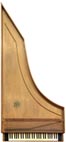
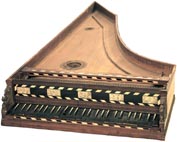
Onofrio Guarracino is today reasonably well known as a maker of rectangular virginals but he also made at least two bentside spinets[1] and a number of harpsichords[2]. The only harpsichord which still retains his signature is the instrument dated 1651 which is the property of Andrea Coen in Rome. However, on the basis of many of the features that they have in common with the other signed instruments by Guarracino, a number of unsigned harpsichords can also be attributed to him. Among these are the harpsichords
-
in the Gemeentemuseum, The Hague (Cat. No. 1933.0543)
-
in the Giulini Collection in Milan (Cat. No. 3[3])
-
in the Metropolitan Museum of Art, New York (Inv. No. 45.41)
-
in the Boston Museum of Fine Arts (Cat. No. 1986.518)
-
in the Museum für Kunst und Gewerbe, Hamburg (Beurmann Collection, Cat. No. 8)
-
the Musikinstrumentenmuseum, Berlin (Cat. No. 4650).
Other harpsichords which may also be by Guarracino are in private ownership in Buenos Aires, in the Palazzo Gritti, Venice and in the Händelhaus, Halle in Germany (Inv. No. MS-69) although I have not had the opportunity to make a detailed examination of the latter instruments. Although several of his virginals are in the Museo Nazionale degli Strumenti Musicali in Rome, it would appear that none of the harpsichords in the catalogue of this museum[4] is by Guarracino even though many of them are certainly Neapolitan in origin. However, a harpsichord in the reserve collection the contents of which have never been published, has recently been discovered[5] that is certainly by Guarracino.
There are many documentary references to Guarracino and much of the archival information about him is known thanks to the hard work and diligent research of Francesco Nocerino[6]. According to Nocerino, even in his own time Guarracino was the most important and respected Neapolitan harpsichord builder in the city[7]. Probably as a result of this high esteem by his contemporaries he was often called upon to give valuations of instruments and estimates of work, and many of the archival references deal with this aspect of his activity. The archives show, for example, that he made a valuation of a mother and child virginal[8] made by one Giovanni Rispolo. The document relating to the evaluation shows for the first time that such instruments were made in Naples, and not just in Antwerp[9] and England[10], as part of a harpsichord builder’s normal activity. This further suggests that, since he knew of their existence, Guarracino may well also have made them himself, although there is no known extant example of this aspect of his work. It is also known that he was involved in the construction and sale of the elusive tiorbino, a gut-strung double-strung keyboard instrument[11].
Francesco Nocerino has been able to find the certificate of baptism of Guarracino[12] in the Neapolitan archives. According to this, Honofrio Antonio Guarracino, son of Fabritio Guarracino and Anna d’Accetto, was baptised in the Church of San Gioseppo Maggiore in Naples on the 4th of January, 1628. He was therefore probably born only a few days before this. This means that he was probably born after 1 January, 1628, although his birth may have take place in the dying days of 1627. His earliest known instrument is the only surviving signed harpsichord which is dated 1651, and was therefore made when he was 24 years old. Guarracino was married in 1654, aged 27, to Ursula Perrone, daughter of Giuseppe Perrone. On the marriage certificate he states his occupation to be cimbarairo[sic] = cembalaro or harpsichord builder. The marriage certificate also makes clear that Guarracino’s brothers-in-law Aniello and Michele Perrone were both wood carvers. One of the features of Guarracino’s harpsichords is their elaborately-carved keyscrolls. Sometimes these take the form of elaborate gilt vine scrollwork, sometimes they are carved in plain wood and are of human or mythological figures, or of cornucopiæ. The family relationship between Guarracino and Aniello and Michele Perrone strongly suggests that one or both of them may have been responsible for carving the keywell scrolls on his instruments [click here and look at point 10 for some examples]. Although the sons of many of Guarracino’s harpsichord-building contemporaries went on also to become harpsichord makers, none of Guarracino’s 8 children continued the tradition built up by their father. One of Guarracino’s sons Francesco, however, is known to have gone on to become a Prorationale della Regia Camera (Administrative Officer of the Royal Chamber). Although the last signed and dated instrument by Guarracino was made in 1694 he is known from the archives through the dealings that he made to have survived at least until 10 January, 1698, by which time he would have been 70 years old. The date of his death is not known, but by 1711 he was declared already to have died by his son Francesco Guarracino. His surviving instruments cover dates during the period between 1651 to 1694.
|
|
|
|
Anon. harpsichord attributed to Guarracino by Grant O'Brien |
Anon. harpsichord attributed to Guarracino by Grant O'Brien |
According to the research of Francesco Nocerino, Guarracino worked in Naples in the Strada del Spirito Santo, near to the Banco del Spirito Santo in the archives of which much of Nocerino’s work has concentrated. At first Guarracino rented a workshop there which was physically connected to the house where he lived. Then, with the passage of time accompanied by his increasing wealth and activity, he was able to rent three apartments in a palazzo with various annexes, a courtyard and a number of workshops. He held accounts in numerous banks throughout Naples and there were regular and consistent movements of funds in and out of these accounts. These included payments for the rent of the buildings he used, and payments for paintings, furniture, glass, instruments, and in respect of the marriage of his daughters. He made numerous loans to persons of all social and economic levels including his own relatives and family. He was also often involved with dealings in used instruments and their repair and resale. Guarracino was obviously a natural survivor: as Francesco Nocerino has pointed out[13] he lived through numerous plagues in Naples, an eruption of Vesuvius, a famine and a major earthquake. He lived through a period of enormous political and economic upheaval and of considerable human adversity. He survived and flourished despite competition and the lower prices at which others offered their instruments. He seems to have enjoyed a high standard of living and a high level of respect from his friends, family and professional contemporaries throughout his working career.
Like makers working throughout Europe during the whole of the historical period, Guarracino based the design and construction of his instruments on his local unit of measurement. Each city and town had its own unit of measurement and the local standard was usual displayed for all to see and use either inside or on an outside wall of the town hall. Carpenters, joiners, land surveyors, cloth merchants, etc would have made up their own rulers from this standard by copying its length onto a piece of wood or metal and dividing up its length into any sub-units of the standard using some geometrical method. Thus each harpsichord maker working in Naples probably also made up their own rulers, possibly as a part of their apprenticeship training, from the town standard and, because of the slight error in transferring the measurement of the standard to their own workshop rulers, there is a kind of individual workshop unit for each maker which is very close, but not exactly equal to the standard held by the town officials. In the case of Guarracino this unit of measurement was 21.622mm rather than the ‘textbook’ unit found in books on metrology of 21.834mm. The difference between these two is easily distinguishable in the instruments of Guarracino when calculating the unit of measurement he used using either the case measurements of an instrument or its lateral string/bridgepin/nutpin spacing. The use in an instruments of this unique and characteristic unit of measurement is one of the most compelling arguments for attributing such an instrument to him. I know of no other maker that uses this unit of measurement in the design and construction of their instruments. It seems likely that, at the end of his career around 1694, Guarracino started to use a unit of measurement closer to the textbook standard value when, for example, he built the little octave virginal by Guarracino in the National Music Museum in Vermillion, South Dakota which is dated 1694. Obviously instruments built from this date or later will probably not use the characteristic 21.622mm unit.
Guarracino did not seem to sign his name on the nameboard of any of his instruments as is more common with some other harpsichord and virginal makers. Instead, if at all, he seems to have signed only the top surface of either the top or the bottom keylevers. Virginals, by virtue of their complicated geometry, are difficult to alter by increasing their compass and number of notes. They therefore normally retain their original keyboards and, in the case of Guarracino, therefore also retain the signature on the keylevers. However, harpsichords are frequently subjected to alterations, the most common being the alteration of a C/E to c3 short-octave compass to a C to c3 chromatic compass, usually with jacks and strings added at both ends of the keyboard to squeeze in the extra notes. Also, as seen here, Guarracino seems often to have made instruments with enharmonic keyboards, often with unusual overall compasses. After the general introduction of sixth-comma temperaments, such enharmonic compasses became redundant. Hence these instruments were also often given new keyboards to bring them up to date with the modern literature and with modern tuning systems. Therefore in many of the instruments that I have ascribed to Guarracino the keyboards and signed keylevers have disappeared in the process of up-dating the instruments in conformity with later musical needs and practices.
Thus in all of the harpsichords that have been ascribed to him here in which the keylevers have been replaced, the signature has disappeared in the process of making the new keyboards. Before 1677[14] Guarracino signs himself on his instruments using the normal Italian form “Onofrio Guarracino”, but after 1677 he uses the more elegant and sophisticated form “Honofrio” (Honofrius in Latin) for his first name. It would seem that by 1677 Guarracino’s social and economic position in Neapolitan society was such that he wanted to reflect this wealth and social situation in the form in which he siged his instruments. In the archival sources the form in which his name would be written would be outwith the control of Guarracino himself except when he actually signs his name. It is not known if Guarracino’s signature in the archival sources follows the same tendency.
There's a lot of information about Guarracino and Guarracino's instruments in an article I wrote recently: 'The single-manual Italian harpsichord in the Royal College of Music, London, Cat. No. 175: an organological analysis', Galpin Society Journal, LXII (2009) pp. 55 – 99 with colour plates pp 194-5.
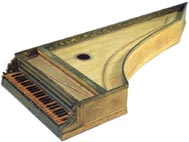
Anon. harpsichord attributed to Guarracino by Grant O'Brien
Royal College of Music, London, RCM 175
-Grant O’Brien, Edinburgh, 01 October, 2008
[1] A spinet in the Museo Nazionale with the catalogue number 898 and thought to be Guarracino is definitely not by him. The two genuine bentside spinets known definitely to be by Guarracino are the instruments dated 1688 in the Museo Nazionale degli Strumenti Musicali, Rome, Nº 888 and another in the Convento delle Suore di Santa Francesca in Naples.
[2] See Donald H Boalch, Makers of the Harpsichord and Clavichord, 1440-1840, 3rd edition by Charles Mould, Clarendon Press, Oxford, 1995) pp. 75 and 343-46. A number of other harpsichords have been attributed by me to Guarracino.
[3] See footnote John Henry van der Meer, Alla ricerca dei suoni perduti - In the search for lost sounds Arte e musica negli strumenti della collezione di Fernanda Giulini - Art and music in the instrument collection of Fernanda Giulini, edited by Fernanda Giulini (Villa Medici Giulini, Briosco, 2006) Cat. No. 3, pp 110-117.
[4] See, for example, the harpsichord mentioned in Maria Luisa Cervelli, La Galleria Armonica, (Istituto Poligrafico e Zecca dello Stato, Rome, 1994) No 779, page 305, Plate page 317. Work by me on the design of this harpsichord indicates that it is also of Neapolitan origin, although it is not by Guarracino. The date 1630 on the top surface of the bottom keylever along with the initials “GA” does, however, appear to be original and authentic.
[5] Personal communication to me by Andrea di Maio. The instrument, typically, is unsigned and undated and has the old inventory number 1827. It has the standard C/E to c3 chromatic compass. Further details of this instrument will be published by me in a forthcoming study just of the harpsichords by Guarracino.
[6] See Francesco Nocerino, ‘Arte cembalaria a Napoli. Documenti e notizie su costruttori e strumenti napoletani’, in Ricerche sul ‘600 Napoletano, Saggi e documenti 1996-1997, Electa Napoli, Napoli, 1998, pp. 85-109 and ‘Napoli centro di produzione cembalaria alla luce delle recenti ricerche archivistiche’, Fonti d’archivio per la Storia della musica e dello spettacolo a Napoli tra XVI e XVIII secolo, (Editoriale Scientifico, Naples, 2001) 205 - 225.
[7] See footnote , ‘Napoli centro - - - ’, p. 210.
[8] See Francesco Nocerino, ‘Evidence for Italian mother-and-child virginals: an important document signed by Onofrio Guarracino’, Galpin Society Journal, 53 (2000) 317 - 321.
[9] See my book, Ruckers. A harpsichord and virginal building tradition (Cambridge: Cambridge University Press, 1990; digital reprint, Cambridge: Cambridge University press, 2008) pp. 35 and 39.
[10] An ‘orphaned’ child virginal by Thomas White, a seventeenth-century English harpsichord and virginal builder, dated 1638 is in private ownership in London, England. This small instrument, as well as clearly being at octave pitch, has a slot in the baseboard through which the jacks of the ‘mother’ instrument must have passed when it was placed on top of the mother instrument so that both instruments could be played at the same time from the keyboard of the mother virginal.
[11] The existence of these instruments and their identification as a type of keyboard instrument was revealed in a paper by Francesco Nocerino entitled ‘The “Tiorbino”: an instrument built by harpsichord makers’, given at the combined meeting of the Galpin Society and the American Musical Instrument Society in Edinburgh on August 8, 2003 (see the end of this footnote). In this paper Nocerino mentions a tiorbino made by Onofrio Guarracino “con tastiatura d’avolio” (with an ivory keyboard). I have been able to show that the ‘spinetta all’ottava’ in the Museo Teatrale alla Scala, Cat. No. MTS TP/04 uses the Neapolitan oncia in its design and construction and that it was therefore made in Naples. It also has many other Neapolitan features such as its rosette, the keyboard which slides in and out like a drawer, etc. Its string scalings do not fit into the normal pattern of metal-strung instruments implying that it should be strung with strings of gut. In my opinion it should therefore be classified as a tiorbino. It has none of the usual features of Guarracino’s instruments, however, and is dated 1707 by which time, if he was even still alive, Guarracino would have been 80 years old. It is therefore probably too late to have been made by him.
See also: Grant O’Brien and Francesco Nocerino, ‘The Tiorbino: an unrecognised instrument type built by harpsichord makers, with possible evidence for a surviving instrument’, Galpin Society Journal, LVII (2005) pp. 184 – 208 with colour plates pp 232-5.
[12] See footnote , ‘Arte cembalaria - - -’, p. 95 where there is an image of the baptismal certificate.
[13] Francesco Nocerino, Harpsichord Makers in Naples during the Spanish viceroys (1503-1707). Recent news and unpublished documents, a paper presented at the combined meeting of AMIS and The Galpin Society, Vermillion, South Dakota, 19-23 May, 2006.
[14] The first instrument by Guarracino to use the form “Honofrio” or “Honofrius” in the signature is the 1677 rectangular virginal in the Museo Nazionale degli Strumenti Musicali, Rome, Nº 901.