
A Franco-Flemish double-manual harpsichord,
made in Antwerp in 1617, and then
stages by Jacques Barberini, Paris, c.1775 and Nicolas Hoffman, 1786.
 |
|
|
|
|
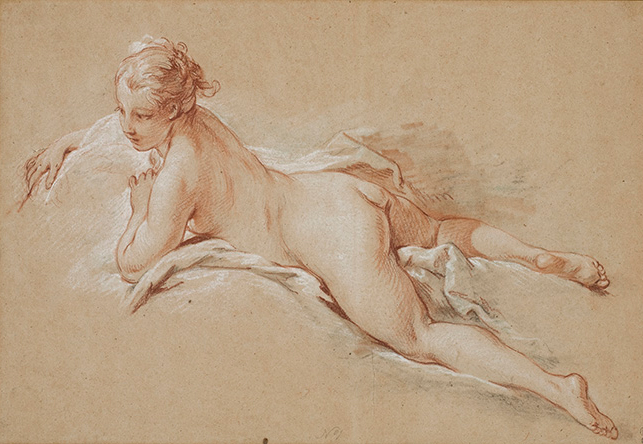
Recumbent Female Nude, François Boucher, 1742-1743 Horvitz Collection, Boston Museum of Fine Arts, Boston |
|
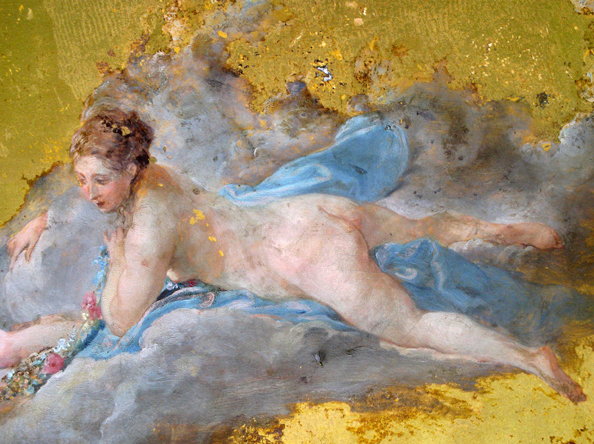
Recumbent Female Nude, François Boucher, 1750 Painting on the outside of the lid, Franco-Flemish Harpsichord Private Collection, London
|
|
The Recumbent Nude
These paintings are by François Boucher (1703-1770) who
was born, worked and died in Paris.
Boucher was a Rococo painter, engraver, and designer. His
career was enormously successful and he received many honours, becoming
Director of the Gobelin factory in 1755 and then becoming both Director of the
Académie and King's Painter in 1765. He
was also the favourite artist of Louis XV's most famous mistress, Mme de
Pompadour, to whom he gave lessons and whose portrait he painted several times
(Wallace Collection, London; National Gallery, Edinburgh).
The close resemblance of the two figures strongly suggests that the paintings on the lid of the Franco-Flemish harpsichord are, indeed, by Boucher who was using the same model with the same position, pose, modelling, etc in both pictures.
Dr Jessica Priebe of the University of Australia in Sydney has kindly pointed out: "the pose of the figure on the harpsichord’s outer case has more in common the earlier Dark-haired Odalisque, of which there are several versions, copies and related drawings dating from c.1742. I believe the sitter of the Franco-Flemish harpsichord fits within this series of works, slight variations of which may have appeared to suit different patrons. Indeed, we know Boucher had a habit of recycling poses from a early age and just to complicate things further, he also used the same models for both female and male figures (but that is a story for another day!). As Alastair Laing has noted, the pose of the sitter of the Dark-Haired Odalisque first appears in 1732 when Boucher used it for an attendant in Venus Requesting Vulcan for Arms for Aeneas, now in the Louvre.
Return to the main page of this section