
A Franco-Flemish double-manual harpsichord,

Details about
the Ioannes Ruckers rosette in the Franco-Flemish harpsichord
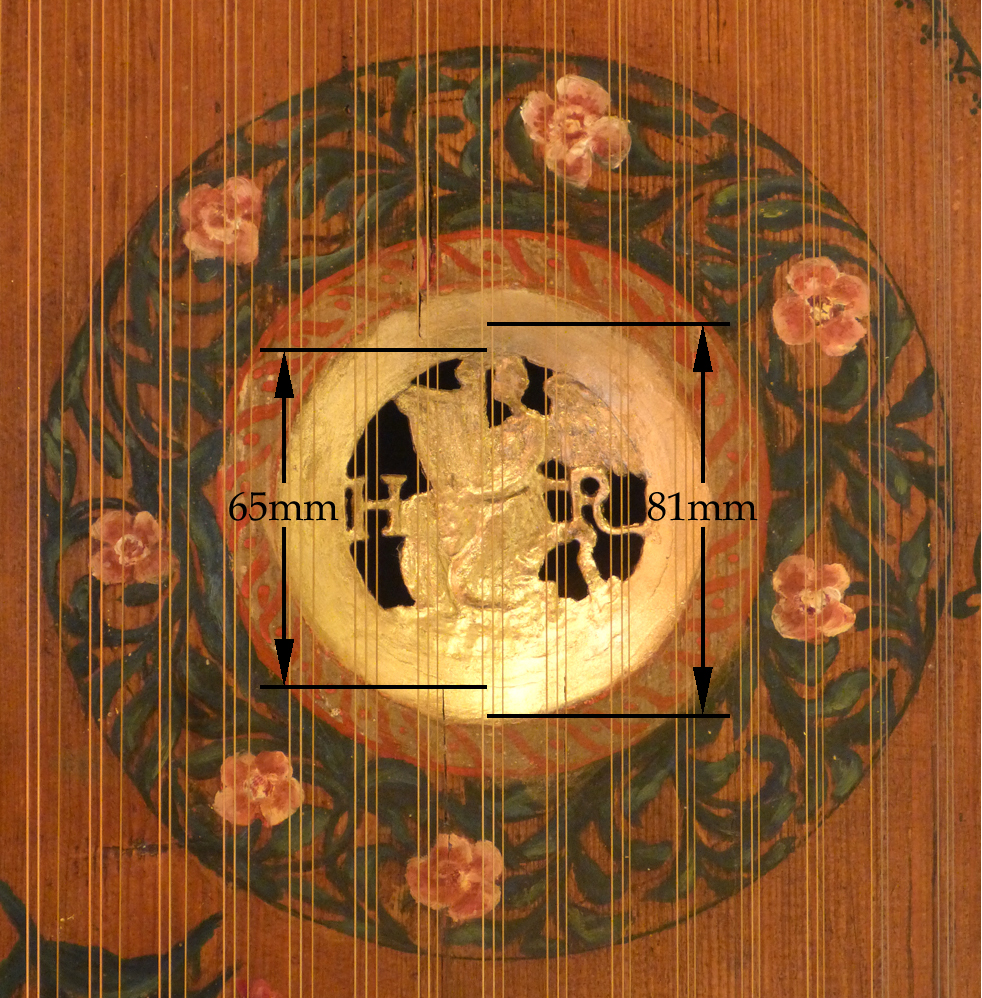
The rosette in the instrument is slightly too small for the hole into which it has been placed. The original soundboard rosette, which was clearly larger, must have been removed, probably in the eighteenth century, and replaced with a genuine “HR” rosette. The replacement rosette is of the type used by Ioannes Ruckers after his father's death in 1598 and until his royal court appointment in 1614. It is very similar to that which is shown in Figure 7.24, page 160 of my book[1].
The original border
of the inside of the hole in the soundboard (81mm) can be seen clearly in places. This is considerably greater than the
diameter of the normal Ioannes Ruckers rosette from the period 1598-1614, which has a diameter of 65mm. Because this rosette has the correct diameter
and is otherwise an identical casting to the rosettes in numerous genuine
Ioannes Ruckers instruments, it appears to be a genuine early Ioannes Ruckers rosette.
The gap between the edge of the rosette and the inside of the bevel in
the soundboard wood has
been filled out with gesso or some other filler.
There are also signs underneath the soundboard of the former existence of a slightly larger soundboard rosette which must have been glued into the instrument sometime before the present one. The present rosette is also not taped to the lower surface of the soundboard with the characteristic four pieces of linen cloth normally used by the members of the Ruckers/Couchet family to hold the rosette in position. Instead the rosette is held here by a single piece of linen cut into a circle and glued all round the rosette. There can therefore be no doubt about this rosette: it is an original Ioannes Ruckers rosette, but is clearly not original to this instrument.
Important
Features of this harpsichord
A brief history of the musical and decorative states of the Franco-Flemish harpsichord
Details of
the original state of the instrument
Details of the eighteenth-century states of this harpsichord
Details of the modern history of this harpsichord
A problem encountered in the ethical restoration of this harpsichord
Return to the main page of this section
[1] Grant O’Brien, Ruckers. A Harpsichord and Virginal Building Tradition, (Cambridge University Press, Cambridge, 1990; digital reprint, Cambridge: Cambridge University press, 2008).