A Franco-Flemish double-manual harpsichord,
A
Brief Musical and Decorative History of the 1617/1750 Frans van Huffel Harpsichord
|
|
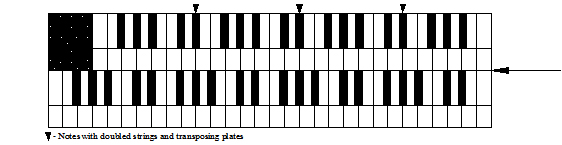
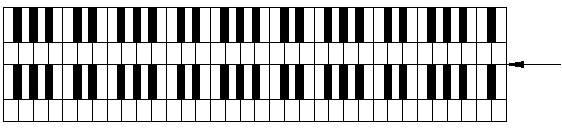
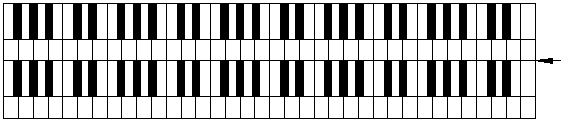
State 1 - 1617. Although the instrument was certainly made it Antwerp, and although it has a genuine Ioannes Ruckers 'HR' soundboard rosette, it was not made by any of the members of the Ruckers/Couchet family. An analysis of the unit of measurement used in the components of its construction shows, however, that these components were all measured out in units of the Antwerp duim, or inch. This is therefore a strong indication that it was made in Antwerp. But although it wasn't made by any of the members of the Ruckers family, the use of the Antwerp duim and the general construction style, makes it a certainty that it was designed and built in Antwerp. The original state can be shown to be typical of a classic Flemish double-manual harpsichord, and recent research indicates that the instrument is by Frans van Huffel, the only member of the Guild of St Luke, other than Andreas and Ioannes Ruckers. The original keyboards were like the keyboards of a normal Ruckers double-manual harpsichord with an upper-manual compass of C/E to c3 at normal pitch, and with a lower-manual compass of C/E to f3 a fourth lower. Also like the normal Ruckers double-manual harpsichord, the disposition was a simple 1 x 8', 1 x 4' on both manual. But also as with the 'classic' Ruckers double-manual harpsichords, there were originally three pairs of doubled strings, now indicated by the presence of doubled 4' bridge pins and doubled 4' hitchpins for these notes where a simple 1 x 8', 1 x 4' disposition would otherwise require only single strings. These are represented in the diagram at the left with small triangles for the eb/g# notes and are required because the g# on the lower manual does no give the correct pitch for the eb on the upper manual. This meant that two string were required - one for the g# on the lower manual, and another for the eb on the upper manual. Such instruments are best known among the output of Ioannes and Andreas Ruckers, were also made by the other harpsichord builders in Antwerp. It can also be shown that the instrument is not by any of the members of the Ruckers family as it has numerous features that are totally different from normal Ruckers practice. |
|
|
State 2 - ?c.1680?. ‘Ghost State’ - the place and the date at which the instrument was given this hypothetical state is also hypothetical!! But it is highly likely that the keyboards were aligned to give them both a compass of G1/B1 to c3 with 50 notes. But, no direct evidence has been found on the instrument of this state,. It is only that this is the usual first alteration between State 1 and State 3 which would follow logically on from State 1, above. |
|
|
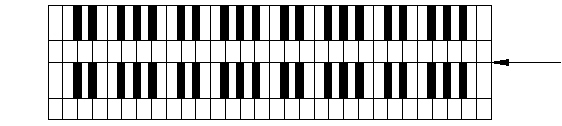
State 3 - c.1700-1735, Paris. Here there is evidence that the compass was G1/B1 to d3 on both manuals each with 52 notes, as indicated by the earliest surviving sections of the lower guides which still survive, although these also have later additions in the treble (see State 5 below). One note was added at the top and one at the bottom of the compass of State 2, thus shifting the whole string band up by a semitone to compensate for the added set of 8' strings. The instrument was probably decorated in some kind of embossed gold ornamentation, like that on the jackrail which has been re-used inside the instrument as a structural brace when it was widened in 1750 in State 4 below. The genuine ‘HR’ rosette may have been inserted at this date to make a new buyer think the instrument was by Hans or Ioannes Ruckers. The rosette may also have been added by François Étienne Blanchet who seems to have made a habit of this kind of practice to increase the sale value of his ravalement instruments. |
|
|
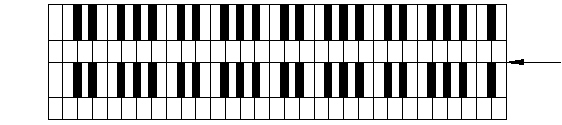
State 4 - 1750, Paris. The bass compass was extended down by 6 notes from B1 to F1 to give a compass from F1 to d3 with 58 notes. Most of the case decoration and the majority of the inner and outer lid decoration also date from this period. The figure paintings and the ornamental decorations on the lid and case sides have been confidently attributed to François Boucher. The top d3 jacks of two of the three surviving rows have the date ‘1750’ written on them, and these and the 57 jacks below them all belong together and to this state. The musical part of this state has been positively attributed to François Étienne Blanchet II (c.1730-1766), ‘facteur des clavessins[sic] du roi’ (see point 2 below). |
|
|
State 5 - 1786, Paris. The work carried out at this time is by Jacques Barberini [active 1782 - 1791] and Nicolas Hoffman [active 1786-1790], although the exact role that each played in the grand ravalement alterations is not clear. The compass was widened in the treble by 3 notes from 58 to 61 notes to give a full 5-octave compass from F1 to f3. This is the present compass and the classic compass of an 18th-century French harpsichord. In this last process of widening the instrument, the cheek was shortened, putting the figures painted in 1750 on the cheek side slightly off-centre. In the process the bentside was lengthened and the join at the treble end of the original bentside was disguised with a kind of floral decoration. |
(State 5 - continued) As part of the ravalement of the Franco-Flemish harpsichord in 1786, it was ‘modernised’ at a time when harpsichords were having to compete with pianos as ‘expressive’ instruments. Having already had 4 registers in its original state, along with the usual 2x8', 1x4' sets of jacks, it was given a fourth row of peau de buffle jacks, and a genouillère to enable the player to ‘swell’ and change the registration and volume of the instrument without need to take his/her hands off the keyboards. Various blocks underneath the keyboards for the genouillère still remain as evidence of this state, but there is now unfortunately no evidence of how the original genouillère might have worked, since this seems all to have been removed by Arnold Dolmetsch. The front surface of the lower full-width belly-rail was inscribed “[Re]fait par N. Hoffmann a Paris 1786” which therefore also gives the date and author of at least one of those who carried out this ravalement. The peau de buffle upper guide from this state was re-used as a lower guide in the 1971 ‘restoration’ by Roberto de Regina in Buenos Aires (see below). De Regina is reported to have found the calling card of Jacques Barberini on the 1786 baseboard (subsequently removed by Barberini and Hoffmann, and so Barberini must also have had a hand in this state, but it seems now impossible to say which features (most of them in any case now being missing) belong to Barberini and which to Hoffmann.
General notes:
There is rigorous scientific evidence that the instrument was originally made in Antwerp and that it uses the Antwerp duim - the thumb or inch - in its design and construction. However, most of the original design principles are quite unlike those found in the instruments built in the usual Ruckers/Couchet tradition. These differences make it clear that it was not originally an instrument made in the Ruckers/Couchet workshops.
The various alterations to the width of the case are visible on the surfaces of the case, lid, jackrail and front flap, although sometimes these are disguised by later decorations. The extensions to both ends of 2 of the 3 surviving registers and to the 3 lower guides are clearly visible, and the number of notes added at each stage tallies perfectly with the above compass history.
There can be no doubt that the surviving case and lid decorations are all from the 18th century, with the exception of some badly-painted additions made around 1889 when the instrument is known to have been owned by Louis Tomasini in Paris. These late decorations are similar to those of Daniel Merlin who decorated some other instruments by Tomasini and others (all now in Berlin) in 1889 for the Exposition Universelle for which the Eiffel Tower was built. Merlin is also known to have decorated some 'Roccoco' pianos made by Ignaz Pleyel.
The
dates that can be associated with this instrument with complete certainty are
the following:
1. 1617 - the date of construction is given in the first edition of the Grove's Dictionary of Music and Musicians, Ed. George Grove (Macmillan Pub., London, 1883) p. 197 which lists those instruments then thought to be by the various members of the Ruckers family. This entry is reproduced here:
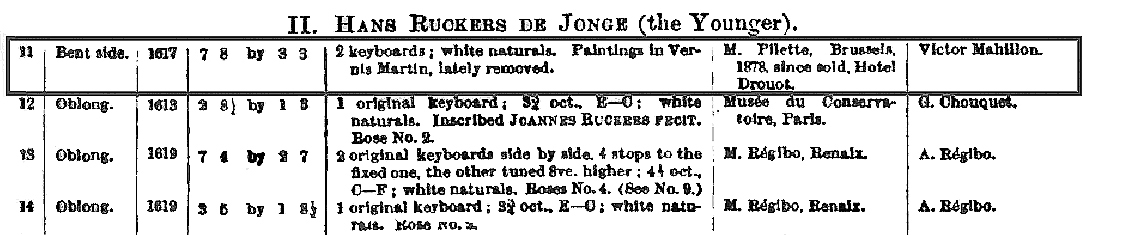
The measurements in the fourth column are all in English inches and are all close to the present total outside measurements of the lid of the instrument. The publication of this entry [1883] follows shortly after the date 1878 when the instrument was known to have belonged to a certain 'M. Pilette' in Brussels. The source of the information is Victor Mahillon, the one-time Director of the Brussels Museum of Musical Instruments. The statement: ‘Paintings in Vernis Martin, lately removed’ in the above entry is certainly not true as these decorations survive to the present day. The later editions of Grove's Dictionary do not give the date, but list the instrument as ‘n.d.’ = no date. The original soundboard decoration, including the painting of the date, seems to have been wiped off the instrument subsequently, and then re-decorated (without a date) by Mabel Dolmetsch when the instrument belonged to Arnold Dolmetsch. Similar details in the subsequent entries in the later editions of Grove's Dictionary make it clear that this entry does, in fact, refer the same instrument.
2. 1750 - the date of the Blanchet ravalement is written on the top jack of two of the three surviving rows of jacks when it had the intermediate compass of F1 to d3 with 58 jacks in each row. This number of jacks corresponds to the width of the instrument when the tail, spine and front board ornaments and the inside and outside of the lid ornaments and paintings were painted and decorated. Many features of the musical alteration which were made to the instrument in 1750 are of absolutely superb quality, typical of the work of François Étienne II Blanchet, who has been positively identified, based on a number of different features, as the author of the ravalement.
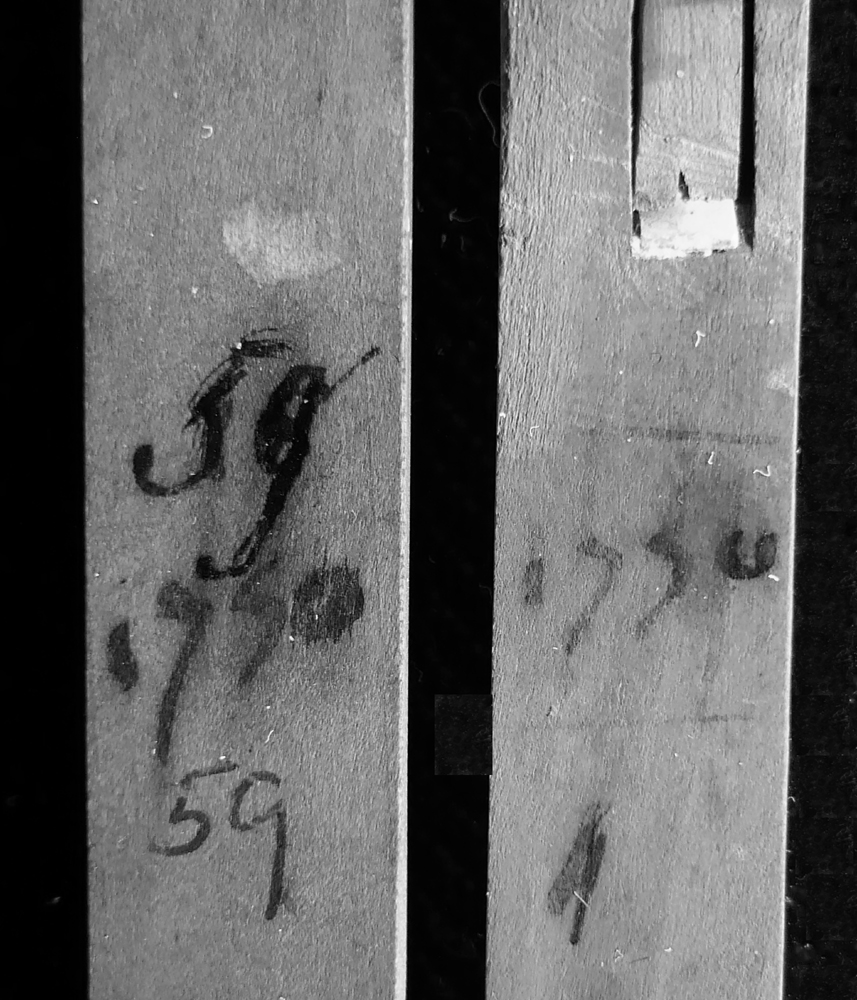
Click here to see a larger image of the date 1750 on the jacks.
3. 1786 - the date and the signature, written (upside down with the instrument in its normal position with the baseboard at the bottom of the case), is by Nicolas Hoffman on the front surface of the full-width lower belly rail. Hoffman's signature on the near surface of the lower belly rail is visible when the keyboards are removed: "[Re]fait par N. hoffman[sic] a Paris 1786". This seems to have been written by Hoffman after the belly-rail had been fixed in place and before the baseboard was attached. In 1786 the instrument was then given a full 5-octave compass from F1 to f3. By this date Louis XV was dead, so that the instrument may then have belonged to Louis XVI. Jacques Barberini must also have worked on the instrument at (or around) this time as his calling card was found glued to the full-width ravalement baseboard when the instrument was owned by Barbara and Wolf Wolf in Buenos Aires. 1786 is probably also the date of the stand since there is no sign on the stand of having been widened from an earlier stand belonging to the 1750 state, when the compass was 2 natural-widths narrower.
4. There is no known record of the history of the instrument between 1786 (3. above) and 1878 (5. below).
5. 1878 - The harpsichord belonged to a certain M. Pilette (I can find nothing about this person) in Brussels according to the first edition of Grove's Dictionary of Music and Musicians (see above).
6. 1889 -1892 - the period when the instrument was owned by Louis Tomasini and when he ‘restored’ the instrument, adding some minor 'extra' elements to the case ornaments. Tomasini probably also had the soundboard painting removed. He is known to have organised concerts in Paris on "Le clavecin doré" - ‘The Gold Harpsichord’, and he also made copies of the instrument on which concerts were given.
7. 13 May, 1927 - The instrument was sold in Sotheby's in London as lot 170. There is no surviving evidence of who the buyer was, but it is likely to have been William Randolph Hearst (see section on the modern history), who bought it along with other art objects to furnish his San Simeon Castel in California.
- Grant O’Brien, July, 2025
Important
Features of this harpsichord
Details of
the original state of the instrument
Details of the eighteenth-century states of this harpsichord
Details of the modern history of this harpsichord
Problems encountered in the ethical restoration of this harpsichord
The attributions of the 1750 state to François Étienne Blanchet and François Boucher
Go back to the main page of this section
This page was last revised on 15 January 2026.