N E W 5 - O C T A V E H A R P S I C H O R D S
I N T H E N E A P O L I T A N S T Y L E
The specifications
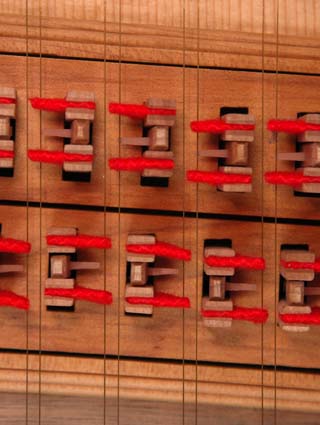
This is a series of integral-construction harpsichords deceiving the eye into thinking that there is a virtual inner instrument in an outer case. The musical part of the instruments are in the style of Onofrio Guarracino who worked in Naples throughout the whole of second half of the 17th century. Howeve, here, the design has been modified to give the instruments a compass suitable for playing most of the 18th-century literature including the music of Scarlatti, Haydn and Mozart. The compass given to the instruments was therefore chosen to be F1 to g3 chromatic, five octaves and a note with altogether 63 notes. They have the normal disposition of 2x8' (see photograph above), and are capable of transposing to either 415Hz or 440Hz.
The length of the case, like that of the harpsichord in the painting by Fabris, is designed to be close to 2400mm or 112 Neapolitan once.
The length of the string sounding pitch c2 is 277mm (f1 is 19 Neapolitan once or f2 is 9½ Neapolitan once) with strings of yellow brass and two different types of red brass wire of differing compositions and strengths on two independent free-standing bridges. The scalings were designed to be Pythagorean, doubling in length with each octave drop in pitch right down to tenor c, 1½ octaves above the lowest note. The plucking points – in conformity with those of other historical Neapolitan instruments – were chosen to be F1 = 8 once, f = 6 once and f3 = 2 once. The octave span has been chosen to be equal to 7½ once. The three-octave span is therefore three times this or 22½ once = 487mm, which is a comfortable span for the human hand and close to the 3-octave span both of Neapolitan and many other historical instruments.
The bridge, like the bridges in many Guarracino and other Neapolitan harpsichords, has been placed 6 once from the bentside. Because of the integral construction of these instruments, although the bridge is 6 once from the ‘virtual’ bentside, it is 6½ once from the actual bentside.
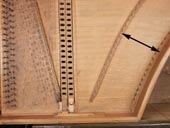
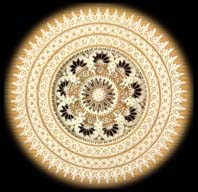
The instruments have drawn some aspects of their design on the best features of other Italian and Neapolitan builders, especially those of Onofrio Guarracino who lived and worked in the second half of the seventeenth century, and Bartolomeo Cristofori who lived and worked at the beginning of the eighteenth century. The are decorated in the usual Neapolitan period style. All parts of the instruments are completely hand made including the keyboard, jacks, tuning pins, bridge and hitch pins, lock, key, hinges, registers and register levers. The latter are to be like the gilt bronze ‘Parthenope’ register levers described elsewhere on this site, and the soundboard rosettes are hand-made by Johnny Bell in parchment and extremely thin layers of either pear or cypress.
The naturals are in either ebony or in box, and the sharps are decorated with inlay or made of a decorative ebony and coloured-wood sandwich. The jacks are made from service wood with beech tongues and shim brass tongue springs in the traditional way.
The Soundboard Wood
Most but not all of the instruments made in Italy in the historical period have fir (abies - usually abies alba) and not spruce (picea) soundboards. Most copies of Italian harpsichords and virginals made today have spruce soundboards rather than the original materials which was almost universally fir (cypress was sometimes used in the earlier instruments). However, all of the harpsichords and virginals made in Naples that I have seen so far have soundboards made of fir. We therefore determined to use fir in these instruments rather than the air-dried spruce from the Forest of Paneveggio in the Italian Dolomites as we had used in our previous Neapolitan instruments.
The problem is that there are no commercial suppliers of soundboard-quality fir known to us in Italy! Fir is available by special request from the Val di Fiemme and the Val di Fassa in the Dolomites but what we have seen was truly of a lamentable quality.
Only one thing to do! Find some good big fir trees in the Apennines, have someone cut down a tree for us and quarter-saw the clean knot-free soundboard-quality wood. Then take it home and let it air dry under the lean-to on the workshop. This we did! So we've now got a supply of nicely-seasoned fir soundboard wood without knots (and lots of fir planks for baseboards, framing, etc with enough knots to go around) to use in the new instruments.
The Other Woods and Materials
The wrestplank and the nuts and bridges are all in Italian walnut. Quilling is in white delrin. The sumptuous decorations are by either Stefano Pessione from Rome or Silvia Morsiani in Imola. These instruments are supplied with a choice of stand and with a choice of either a simple or an elaborate music desk.
The basic instrument comes supplied complete with simple stand, simple music desk, tuning key, tuning fork, retouching paints, and spare strings and quills and these are all included in the basic price. The decoration, type of stand and music desk, etc. can be negotiated and quoted on request. We encourage you to do so!!
Return to the main 'Mozart' harpsichord design section