F L E M I S H P A P E R S
Designs made from wood blocks
hand cut by Grant O’Brien
Please see the important links at the bottom of this page.
Catalogue of the Flemish paper designs
The numbering of the papers in this catalogue refers to the numbers given to the patterns in my book Ruckers. A harpsichord and virginal building tradition (Cambridge: Cambridge University Press, 1990; digital reprint, Cambridge: Cambridge University press, 2008) pages 128-144.
The lengths given in the details under 'Description' below are the total usable length and are given to enable you to calculate the number of patterns you will need to cover the space you require on your instrument. You will notice that the width of many of the patterns is variable. The width depends on how many of the horizontal black lines bordering the top and bottom of the pattern are used when applying them to the instrument. The patterns that are used in the soundwell of an instrument, as a border paper or as a jackrail paper, have 'extra' lines above and below the main pattern. As many of these as necessary can be cut away to fit the space available or to suit the space and design of the lid, keywell, jackrail or other space taken up by the paper.
The tops and bottoms of each strip pattern and all of the edges of the 'silk' pattern are marked with small vertical and horizontal marks indicating where they are to be cut in order for the pattern to 'flow' correctly from one strip to the next in order to repeat the pattern without interruption. The lengths given are the distances between these marks and not the total length of the supplied printed paper, some of which has to be wasted in the process of cutting the papers to length. When applying these papers it is important to cut the pattern to length first using the marked cuts at the top and bottom of the strip pattern. Then, when the strip has been cut to length, it should be trimmed of some or all of its horizontal top and bottom lines to fit into the space required.
The lengths given are those that you must use to calculate the number of strip patterns that you will need to decorate your instrument. Make sure that you allow for a small amount of waste caused by accidental damage to the papers during gluing - for example when gluing the papers around an inside corner of the case.
The numbering of the papers below follows the same numbering system which I used to describe the papers in my book Ruckers. A harpsichord and virginal building tradition on pages 131-144. Some 'extra' paper types have been cut and printed to make the negative image of the type extant on the old instruments (e.g. O'Brien Type 5a, O'Brien Type 7 reverse, etc.). The 3 patterns at the end of the catalogue also do not exist on any extant instruments but were taken from the book La fleur de la science de pourtraicture. Patroms de broderie, facon arabicque et ytalique, (Paris, 1530; reprint Jean Schmidt, Paris, 1908) by Francesco Pellegrino, the same book used for a number of the extant patterns found on Flemish instruments and by those of other Flemish makers. These all work very well on instruments decorated in the Flemish style.
Click on the image at the left for a larger view of a portion of each of the paper strips
|
Image |
Detail |
Description |
|
|
|
O'Brien Type 1 - The green 'silk' paper The green 'silk' pattern used as a background in the lid of both harpsichords and virginals and sometimes in the keywell flap. Dimensions: 368mm x 249mm The colour of the papers provided may vary slightly from that shown here. However the printed colour has been carefully matched to the cleaned and restored lid papers on the 1651a AR harpsichord in Traquair House, Innerleithen, near Edinburgh. |
 |
 |
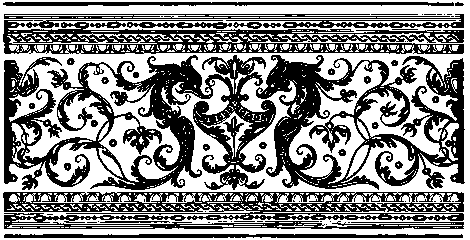
O'Brien Type 3 - The white dolphin pattern Perhaps the most famous of the Flemish block-printed paper patterns. This is used for the front and keywell of Flemish virginals, but is also suitable for single-manual harpsichords although, used there, some of the pattern needs to be cut away. It is not really suitable for double-manual harpsichords since then most of the pattern needs to be cut away because of the space occupied by the upper manual. Dimensions: 361mm long x 131-177mm wide |
|
|
|
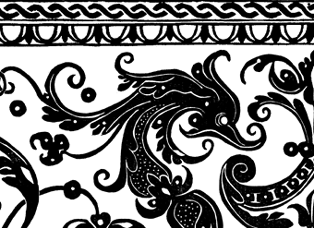
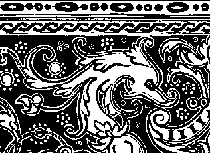
O'Brien Type 4 - The black dolphin pattern Like Type 3, this is one of the most popular and one of the finest of the Flemish block-printed paper patterns and, unlike Type 3, this patter has much more detail than the white seahorse pattern. It is used in the same way as O'Brien Type 3 above and, like type 3, is also not really suitable for double-manual harpsichords. Dimensions: 356mm long x 128-191mm wide |
|
|
|
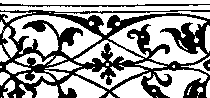
O'Brien Type 5 An excellent pattern for the keywell of double-manual harpsichords where it needs to be doubled in width at the sides of the keywell. Used in this position the edge borders are not used between the doubled pattern. It is also used on the outside of the case of many of the 'child' virginals. Dimensions: 373mm long x 74-88mm wide |
|
|
|
O'Brien Type 5a This paper is not actually found on any known Flemish instrument, but is made from a block that gives a colour reversal and a mirror image of design 5 above. It may well have been used in the Antwerp harpsichord-building workshops but has not survived. It is the pattern used to make the paper on the dust jacket of my book on the Ruckers family tradition. It can be used in the same way as Type 5 above. Dimensions: 377mm long x 79-93mm wide |
 |
 |
O'Brien Type 7 Unlike all of the others, this paper has been re-constructed digitally from a scaled photograph of the original paper on the 1633a AR 6-voet muselar virginal in the Museum of Musical Instruments in Brussels. It reproduces many of the defects in the original paper. It makes a fine border paper to the 'silk' pattern in the lid and front flap of virginals, or it can be used effectively as a soundwell paper above the soundboard in any kind of early keyboard instrument. Dimensions: 386mm long x 38-44mm wide |
 |
 |
O'Brien Type 7 reverse The reverse of photograph of the original paper on the 1633a AR 6-voet muselar virginal in the Museum of Musical Instruments in Brussels. It also makes a fine border paper to the 'silk' pattern in the lid and in the front flap of virginals. Or it can be used effectively as a soundwell paper above the soundboard. Dimensions: 386mm long x 38-44mm wide |
|
|
|
O'Brien Type 9 This is the narrowest of all the Flemish paper patterns. It is therefore often used as a border to the 'silk' paper in the lid or front flap of Flemish clavecimbels. It is really the only border pattern that can be used on the main section of a harpsichord lid because anything wider than this is very difficult to 'bend' along the bentside shape - or sections of the pattern need to be cut out in wedges so that the pattern 'flows' along the bend . This is the strip pattern I use as a logo throughout my website and on my stationery. Dimensions: 370mm long x 24-32mm wide |
|
|
|
O'Brien Type 13 An excellent pattern to use to line the soundwell - usually without the lower line borders. It also makes a good lid border in virginal lids. Dimensions: 376mm long x 33-42mm wide |
|
|
|
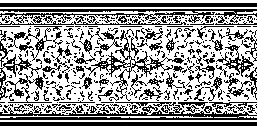
O'Brien Type 14 The negative of O'Brien Type 13 used for the same purposes. Dimensions: 375mm long x 33-38mm wide |
 |
 |
O'Brien Type 15 An unusual and unique paper that exists only on the 1598 spinett virginal in Paris. This is the same pattern as the paper seen on the inside surface of the front flap of the virginal in the famous The Music Lesson by Jan Vermeer. This paper is provided with two 'extra' border strips which can be used at either end of the pattern for a virginal or harpsichord front flap. This paper is not really suitable as a keywell paper. Dimensions: 402mm long x 158-175mm wide |
|
|
|
O'Brien Type 16 Another excellent soundwell lining paper which can also be used as a virginal lid border paper. Dimensions: 384mm long x 32-44mm wide |
|
|
|
O'Brien Type 16 reverse This is the reverse of O'Brien Type 16 and can be used for the same purposes. Dimensions: 382mm long x 32-44mm wide |
|
|
|
O'Brien Type 21 This is most often found in the keywell of double-manual harpsichords, where it is doubled in width at the sides of the keywell, and left as a single width above the upper-manual keys. At the sides, the edge 'rope' borders are not used between the doubled pattern above the upper-manual keys. Dimensions: 378mm long x 132-139mm wide |
|
|
|
O'Brien Type 22 The negative of O'Brien Type 21 and used for the same purpose. Dimensions: 378mm long x 132-138mm wide |
|
|
|
O'Brien Type 24 This block was cut many years ago, not by me, but by John Barnes. It lacks the marks to indicate where to cut the ends, and it does not really 'flow' from one pattern to the next. This pattern is often used on the top of double-manual harpsichord jackrails. Dimensions: 360mm long x 47 - 57mm wide |
|
|
|
O'Brien Pellegrino 1 This pattern is the right width and works well in the soundwell of an instrument, or as a lid border paper. Dimensions: 365mm x 35-49mm wide |
|
|
|
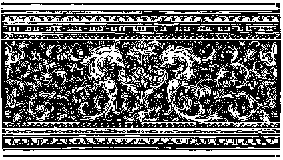
O'Brien Pellegrino 2 Another Pellegrino pattern made by me. This can work very well on the top of the jackrail in double-manual harpsichords. Dimensions: 342 mm long x 53-63mm wide |
|
|
|
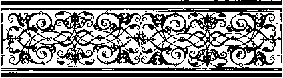
O'Brien Pellegrino 3 The inverse of O'Brien Pellegrino 2 above, which can be used for the same purpose. This is perhaps the most delicate and graceful of all of the patterns I produce. Dimensions: 343mm long x 55-68mm wide |

























Prices of machine-printed Flemish papers.
Prices of hand-printed Flemish papers
How to pay for the Flemish papers you have ordered
Hints on laying the Flemish 'silk' paper (O'Brien Type 1)
Hints on decorating the papers after they are laid.
The 'Vermeer' paper (O'Brien Type 15)
Drawings are available some of which show how to decorate the papers after laying
The Ruckers book has been re-published by CUP. Buy a copy signed by the author
Return to the main page of this section